THNKS FR TH MMRS
Have I got a story for you.
The year was 1986. And after falling ill from a virus that nearly killed him in his late 30s, Clive Wearing emerged from his sickness physically as healthy as he was before. Everything read normal. Except for one thing...
Every seven seconds, his memory went blank.
Clive has one of the worst cases of amnesia known to the world. His working memory is completely intact, allowing him to continue conversations presently, from moment to moment. But he has no long-term memory of anything before the illness, nor any new short-term memories past it. Every seven seconds, he is a new blank slate.

But if you sit him in front of a piano...
he’ll play Beethoven’s Moonlight Sonata,
or Debussy’s Clair de Lune,
or Tchaikovsky’s Dance of the Sugarplum Fairy.
(Don’t mind me while I flex that music minor.)
You see, before his illness, Clive was a renowned musician and concert pianist. He had spent most of his adulthood performing, conducting, and even composing incredible concert pieces of his own. He understood music — the theory, the key signatures, the ins and outs. His instrument of choice was the piano, and he knew exactly where and how all 88 keys interlaced together and more importantly, he knew why.
But just moments after performing, Clive would tell you he’s never heard a musical note before.
How is this happening?
Despite the impact that his sickness had on his short-term, long-term, and working memory capacity, Clive’s procedural memory was still intact.
Our procedural memory includes things like walking, talking, driving, turning on a light switch, eating, or drinking. These are things that become so second-nature we no longer have to think about them, we just know when and how to do them. Which, in Clive’s case, included playing the piano.
Music, Memory, and Mastery
In case you’re not familiar with music theory, think of it this way:
Music has rules.
There are foundational things that must stay in place for the music to sound like you want it to.
It’s sort of like learning the rules to a language before you can speak it coherently.
Once you’ve devoted the time and thoughtfulness it takes to
learn those (very hard-to-learn) rules, and
apply them to your own instrument,
you can simply speak music, without having to think about it.
This is also called mastery.
And once you achieve mastery in a skill, it becomes like second nature. And as Clive has shown us, you only need working memory to do that.
Imagine what it would be like to become so masterful at a skill, that you don’t even need to remember how you learned it. It just becomes a part of you.
This is how deeply I want you to understand your shot.
The Path to Mastery
In order to achieve mastery, you must
understand the foundations, and
learn how to apply them to your own shot.
This is what we’ll do during a 4-Day Intensive.
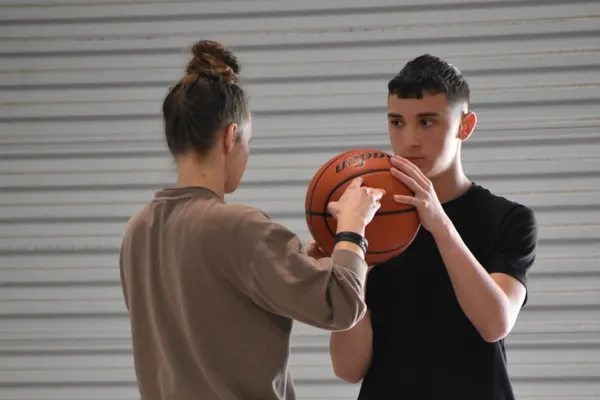
We’ll spend two hours on-court each day, finding your foundations through high-volume reps and deliberate practice.
At the conclusion of each court session, we’ll spend one hour in the classroom — where I’ll teach you the theory and the language of shooting, and how to speak in the way that works for you.
We’ll cover your mind, your body, your power, and your accuracy and you will be a more confident and capable shooter than you were before. But most importantly, you’ll be left with a lasting approach that will stretch far beyond your jumpshot.
This is not to say you’ll be a master of shooting in four days. That would be a false promise. But what you will leave with are all of the tools you could possibly need to do just that.
Upcoming Availability
All of that being said, I wanted to share my schedule for the next five months.
My immediately free dates are anytime in April, or after August 19th. I’ll be taking the first two weeks of May to prepare my mind and body for my camp season!
If this is something you think you or your athlete is ready to commit to, you can go to this page.
I want you to understand your movements in the way that Clive Wearing understands his music. I want you to reach mastery.
And I can’t wait to get started. :)
I’ll see you next blog. 🔥
Shooters Shoot.
BriAnna
P.S. Among the things I covered during college, by far my favorite thing to study was memory.
I even conducted my own research on memory during undergrad. My study focused on the connection between our sense of smell and its impact on our referential memory which are the things we try to remember that aren’t autobiographical, like a list of facts or general information.
And... the results were pretty cool. :)
There is indeed a connection, and this research suggests you should set your study environment up with the same smell that will be present during testing. Who knew?
If you’re (also) a total nerd and want to read more about that, feel free to read that paper [here].